


Share this article

Table of Contents

How to Introduce AI Assistants Without Losing Technician Trust

How to Introduce AI Assistants Without Losing Technician Trust

Table of Contents

Key Takeaways

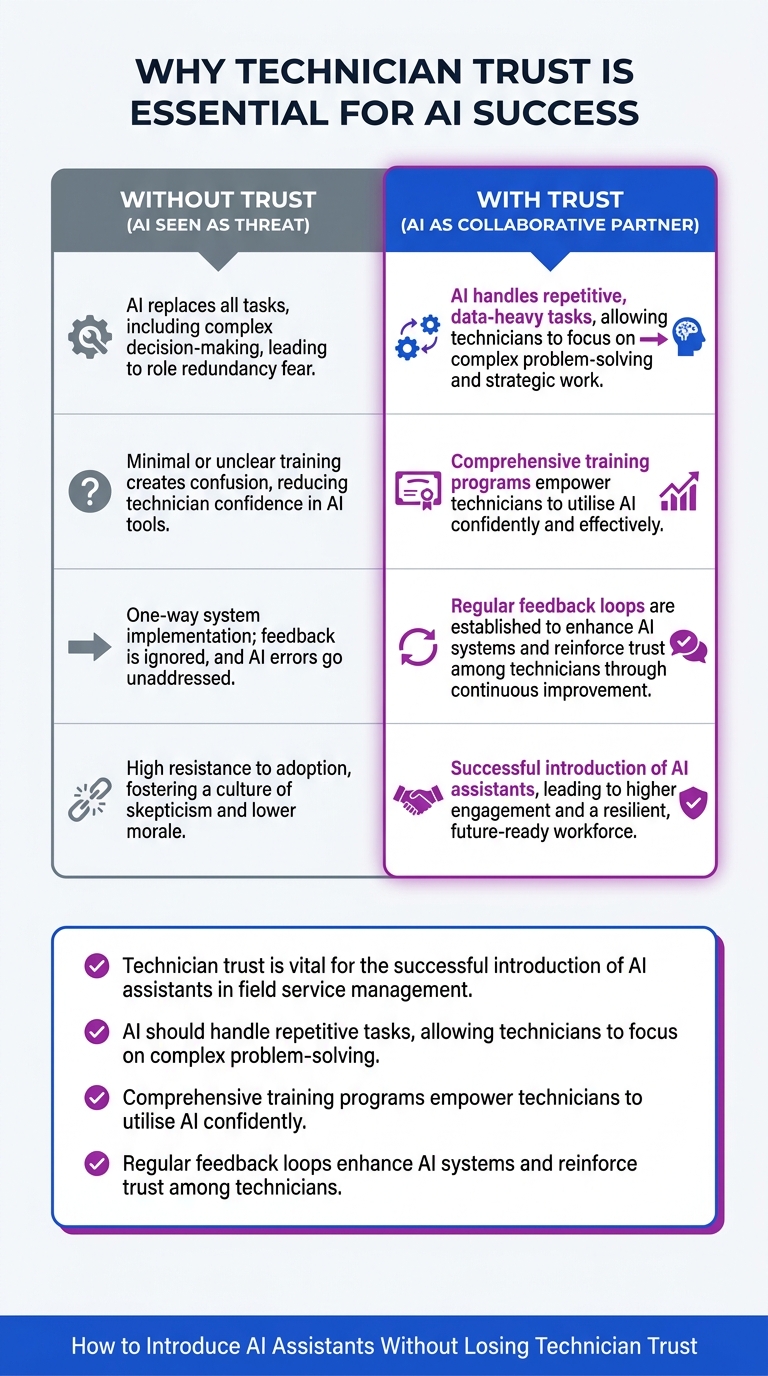
  • Technician trust is vital for the successful introduction of AI assistants in field service management.

  • AI should handle repetitive tasks, allowing technicians to focus on complex problem-solving.

  • Comprehensive training programs empower technicians to utilise AI confidently.

  • Regular feedback loops enhance AI systems and reinforce trust among technicians.

Key Answer

Learn how to introduce AI assistants in your business without compromising technician trust. Equip your team with the right tools to enhance productivity and service quality.

In the ever-evolving landscape of trades and services in Australia, the introduction of AI assistants promises to revolutionise how tasks are performed, enhancing productivity and service quality.

However, it’s crucial to address the elephant in the room: How do you introduce AI assistants without losing technician trust? This is a question many business owners grapple with as they strive to integrate technology without undermining the confidence and expertise of their skilled workforce.

AI in field service, particularly through field service software, is not about replacing human expertise but rather augmenting it to optimise efficiency and service delivery. This article delves into strategies that ensure AI assistant for business complements rather than competes with the technician’s role, fostering an environment where human oversight is paramount, and technology serves as a powerful ally in delivering exceptional customer service.

Why Technician Trust Is Essential for AI Success

Building trust among technicians is the cornerstone of successfully integrating AI into your business operations. Trust ensures that your team is open to embracing new technologies without fearing job displacement. When technicians believe that AI tools are designed to support rather than replace them, they are more likely to engage positively with these systems.

In Australia’s trades and services sector, where expertise and on-the-job experience are highly valued, AI in field service should be presented as a complement to human skills. By portraying AI as a tool that enhances job performance, such as predictive maintenance alerts or optimised scheduling, technicians are more likely to view it as an invaluable resource rather than a threat.

Establishing trust requires transparency from management. Clearly communicate how AI systems work, what data they collect, and how this information will be used. This openness helps alleviate concerns of surveillance and empowers technicians by involving them in the implementation process.
infographic_gpXjfmWxK8.jpg

Start with the Jobs Nobody Enjoys

AI’s potential is best realised when it takes on the repetitive, mundane tasks that often bog down technicians. Start by deploying AI assistants for business in areas like data entry, routine monitoring, and simple diagnostics. These are the kinds of tasks that typically consume significant time and can lead to frustration among skilled workers.

For example, in the electrical sector, AI can handle inventory management by keeping track of parts used and automatically reordering supplies when necessary. In plumbing, AI could monitor water usage and predict potential leaks before they cause significant damage. By relieving technicians of these less desirable tasks, they can focus on more complex, satisfying work, ultimately boosting job satisfaction and productivity.

Additionally, this approach sends a clear message that AI is a supportive tool designed to enhance work-life balance rather than add to workload stress.

Keep People in Control of Every Decision

A critical factor in maintaining trust is ensuring technicians remain in control of decision-making processes, even when AI is involved. AI should be a tool that provides options and insights, but the ultimate decision should lie with the human expert.

In field service management, for instance, AI can suggest optimal routes for technicians based on real-time traffic data. However, the technician should have the final say, using their local knowledge and experience to make the best decision for the task at hand.

Integrating a feedback loop where technicians can provide input on AI recommendations and adjustments can further reinforce this trust. This process ensures that AI systems learn from real-world experience, becoming more attuned to the actual needs and nuances of field operations.

How AI Supports Better Field Service

AI in field service empowers technicians by providing them with data-driven insights that enhance service quality and efficiency. For instance, AI-powered predictive maintenance tools can alert technicians to potential equipment failures before they occur, allowing for proactive repairs and reduced downtime.

In the HVAC industry, AI can analyse historical data and current conditions to optimise system performance, ensuring comfort and energy efficiency for clients. Similarly, security firms can use AI to monitor surveillance feeds, highlighting unusual activity and reducing the burden on human operators.

Field service software with AI capabilities streamlines operations by automating scheduling, dispatching, and customer communications, enabling technicians to focus more on delivering exceptional service. By using AI to handle the administrative side of field service management, technicians can devote their skills to critical, hands-on tasks.

Training Your Team to Use AI with Confidence

Training is vital to ensure your team can use AI technology effectively and confidently. A well-structured training programme demystifies AI tools and shows technicians how these can enhance their roles rather than replace them.

Start with workshops that provide hands-on experience with AI software, allowing technicians to explore functionalities in a low-pressure environment. This could involve training in using AI to perform diagnostics or navigate field service software. By equipping your team with the necessary skills, you bolster their confidence and reduce apprehension about the new technology.

Ensure ongoing support is available, with resources such as online tutorials, help desks, and peer mentoring. By fostering a culture of continuous learning, your team will be more adept at integrating AI into their daily routines, optimising both individual performance and overall business operations.

Measuring the Success of Your AI Assistant

Evaluating the effectiveness of AI deployment is essential to ensure that it meets the intended goals without compromising technician trust. Establishing clear metrics and benchmarks for success is crucial in this regard.

Consider metrics such as time saved on routine tasks, reduction in errors, or improvements in customer satisfaction scores. Regular reviews and feedback from technicians can provide insights into the AI’s performance and areas for improvement.

Feedback loops not only allow for the fine-tuning of AI systems but also empower technicians to take ownership of the technology, ensuring its alignment with operational needs and expectations. This process reinforces trust by showing that their opinions and experiences directly impact AI development and deployment strategies.

Common Mistakes When Introducing AI

Introducing AI into your business requires careful planning to avoid common pitfalls. One major mistake is failing to involve technicians in the selection and implementation process. Technicians who feel excluded may be less likely to embrace the technology, fearing it as a threat rather than a tool.

Avoid over-reliance on AI by maintaining a balance between technology and human oversight. AI systems should support human judgement, not replace it. By ensuring that AI complements rather than controls operations, you preserve the autonomy and expertise of your workforce.

Finally, neglecting proper training and communication can result in misunderstandings and resistance. Comprehensive training programs and open dialogues about AI’s role and benefits are key to mitigating these issues.

Building a Future Where AI and Technicians Work Together

As AI technology evolves, the vision for the future is one of collaboration rather than competition between humans and machines. By embracing AI as a partner in field service management, technicians can leverage data-driven insights to enhance their skills and deliver superior customer service.

AI’s role in handling repetitive tasks allows technicians to focus on complex problem-solving and customer interaction, areas where human intelligence and empathy shine. This synergy not only boosts productivity but also enhances job satisfaction and career development opportunities.

As you look to the future, remember that AI is a tool designed to empower your workforce. Through careful implementation, training, and ongoing support, you can build a workplace where AI and technicians thrive together, paving the way for innovation and growth in the trades and services industry.

At i4T Business, we are building AI-powered capabilities that will work as a collaborative partner for technicians to fast-track their work, not replace their skills or judgement.

Frequently Asked Questions

Technician trust ensures that the workforce is receptive to AI tools, viewing them as supportive aids rather than threats, thus facilitating smoother integration and enhanced productivity.

AI enhances field service by automating routine tasks, optimising scheduling, and providing data-driven insights that improve service quality and technician efficiency.

Avoid failing to involve technicians in AI implementation, over-relying on AI without human oversight, and neglecting comprehensive training and communication.

Technicians should undergo hands-on training sessions to explore AI functionalities, supported by ongoing resources like online tutorials and peer mentoring.

Success can be measured by evaluating time saved on tasks, reduction in errors, and improvements in customer satisfaction scores.

Welcome to i4T Global Ecosystem!

Signup for a New account