


Key Takeaways
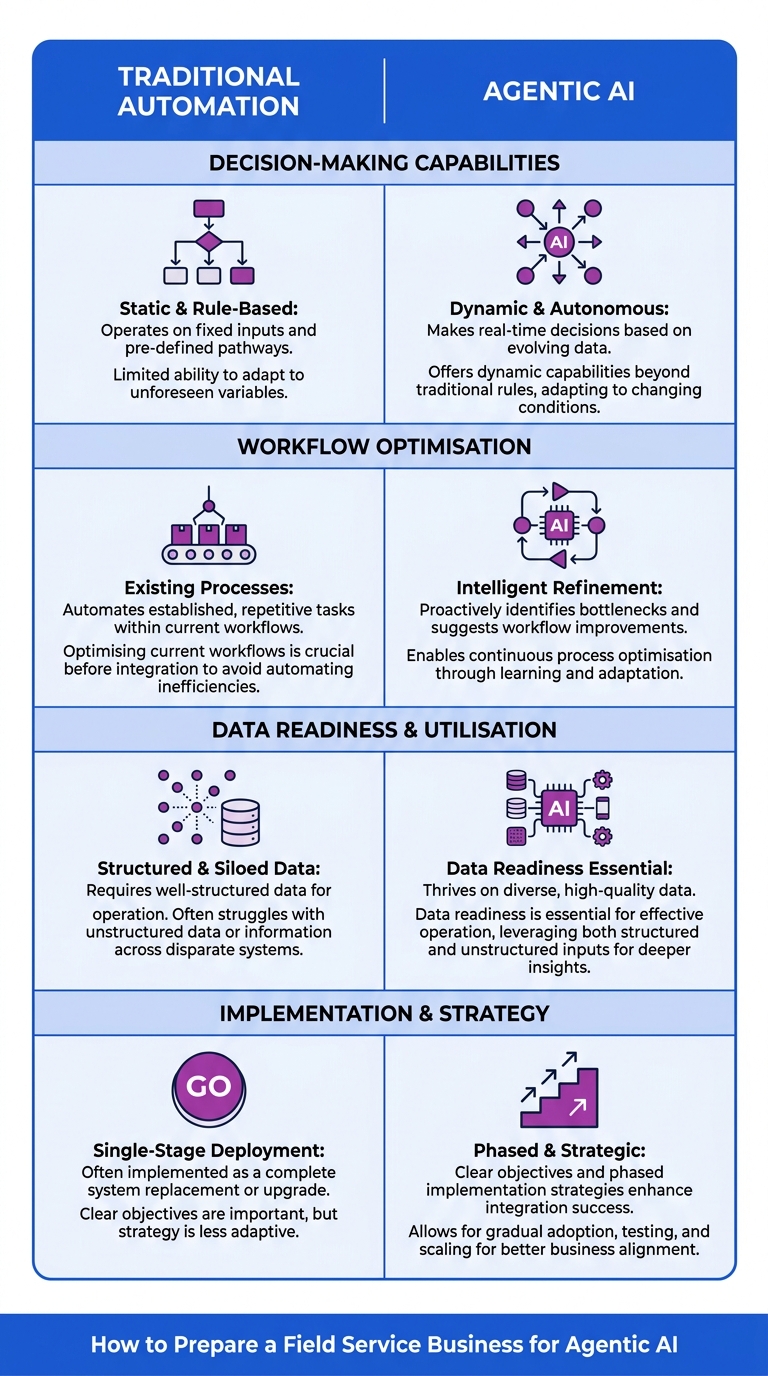
Agentic AI offers dynamic decision-making capabilities beyond traditional automation.
Optimising current workflows is crucial before integrating AI systems.
Data readiness is essential for effective AI operation.
Clear objectives and phased implementation strategies enhance AI integration success.
Key Answer
Learn how to prepare your field service business for agentic AI with strategies for workflow improvement, data organisation, and staff training, tailored for Australian tradies.
In today’s rapidly evolving technological landscape, understanding how to prepare a field service business for agentic AI is crucial for staying competitive. This guide is specially tailored for Australian tradies looking to embrace the next wave of innovation. Agentic AI, unlike traditional automation, offers dynamic decision-making capabilities that can revolutionise how field services operate.
As you embark on this journey, it’s essential to explore the core components of integrating agentic AI into your business. From improving workflows to ensuring data readiness and training your team, this comprehensive guide covers it all.
Let’s dive into how you can prepare your field service business for the exciting world of agentic AI.
What Is Agentic AI and Why Does It Matter?
Agentic AI represents a significant leap beyond traditional automation by enabling systems to autonomously make decisions based on data inputs. Unlike conventional automation, which follows pre-set rules, agentic AI can dynamically adapt to changing conditions. This makes it ideal for field service businesses where variability and unpredictability are common.
Imagine a system that not only schedules your team’s daily tasks but also adjusts them in real time based on traffic conditions, emergency requests, or equipment availability. By doing so, agentic AI optimises efficiency and enhances customer satisfaction. This technology is pivotal for industries such as electrical, plumbing, HVAC, and fire safety, where real-time decision-making can save both time and resources.
Build Better Processes Before Adding AI
Before integrating agentic AI into your operations, it’s crucial to ensure that your existing processes are optimised. Start by mapping out your current workflows and identifying bottlenecks or inefficiencies. Use technology to streamline these processes where possible.
For example, in the electrical field, integrating mobile apps that allow technicians to access job details on the go can significantly reduce downtime. Similarly, plumbing businesses can benefit from automated scheduling systems that assign jobs based on location and urgency. These improvements lay the groundwork for the seamless introduction of agentic AI.
Make Your Business Data AI Ready
Data is the lifeblood of any AI system, and ensuring your data is organised and accurate is a critical step towards AI readiness. Begin by auditing your current data collection practices. Ensure that all data points are relevant, accurate, and consistently recorded across all operations.
For HVAC companies, this might involve systematically recording equipment performance data, while cleaning services might track customer feedback and service durations. By organising this data effectively, you set the stage for AI systems to learn and make informed decisions, thereby boosting efficiency and customer satisfaction.
Create a Practical AI Implementation Strategy
Developing an AI implementation strategy involves setting clear goals and benchmarks. Ask yourself what you aim to achieve with AI integration. Is it reducing operational costs, improving service quality, or increasing customer engagement? Clearly defined objectives will guide your AI adoption process.
Consider creating a phased rollout plan where you start with pilot programs in select areas of your business. For instance, security firms might first implement AI in their monitoring systems before extending it to scheduling and dispatching. This approach allows you to test and refine the AI’s capabilities before a full-scale deployment.
Keep People at the Centre of Every Decision
While AI can enhance operational efficiency, it is essential to keep the human element central to your strategy. Ensure that your team remains empowered and in control of AI-driven processes. Provide training programs that highlight how AI tools can assist rather than replace their roles.
In industries like maintenance and fire safety, human judgment is irreplaceable. AI should be viewed as a tool to augment capabilities, allowing technicians to focus on more complex tasks that require human intuition and expertise. Emphasising the partnership between AI and human workers will lead to a more harmonious and productive workplace.
Prepare Your Team for AI Adoption
Training your team is vital for a smooth transition to an AI-augmented workflow. Develop a comprehensive training program that covers the basics of AI and its application in your specific industry. Use hands-on workshops to demonstrate the AI tools in action.
For instance, cleaning companies could benefit from training their staff on using AI for task allocation and supply management. Meanwhile, in the HVAC sector, technicians should learn how AI can predict maintenance needs, reducing unscheduled downtime. Effective training ensures that your workforce is comfortable and competent in using AI technologies.
Assess Your Enterprise AI Readiness
Before fully committing to AI implementation, assess your business’s readiness. This involves evaluating your current technological infrastructure, financial resources, and staff capabilities. Conducting an enterprise AI readiness assessment will help identify gaps that need addressing.
In the security sector, ensuring that your systems are compatible with AI technology is essential. Similarly, for plumbing businesses, it may involve upgrading to IoT-enabled devices that facilitate AI integration. By comprehensively assessing readiness, you can tailor your approach to ensure successful AI adoption.
Your Roadmap to Becoming AI Ready
Becoming AI ready is a journey that requires careful planning and execution. Start by prioritising which areas of your business will benefit most from agentic AI. Develop a timeline with specific milestones for each stage of your AI integration plan.
Consider leveraging existing tools and platforms that are already optimised for AI, such as field service management software.
Platforms like i4T Business offer solutions tailored for field service businesses. By adopting these strategies, your business will be well-prepared to harness the full potential of agentic AI.
Frequently Asked Questions
Agentic AI refers to AI systems capable of making autonomous decisions based on real-time data, enhancing adaptability and efficiency in operations.
Ensure data is accurately recorded, relevant, and systematically organised to facilitate effective AI learning and decision-making.
Training ensures your team understands AI tools, enhancing their ability to work effectively alongside these technologies.
Key steps include optimising workflows, ensuring data readiness, setting clear goals, preparing your team, and assessing your technological infrastructure. Engage with existing AI-optimised platforms to streamline the integration process.
Unlike traditional automation, which follows predetermined rules, agentic AI adapts to changes in real-time, making autonomous decisions based on data inputs.