TL;DR
AI can save strata managers a lot of time when it’s used for admin-heavy work like sorting maintenance requests, drafting resident updates, summarising job notes, and speeding up committee reporting.
It can also support AI for predictive maintenance in strata buildings when you have clean asset and work order data, helping you spot repeat failures and plan ahead.
The risk rises when AI is used for compliance, safety decisions, privacy-sensitive information, or official reporting. The biggest trap is AI sounding confident while being wrong or making assumptions.
The safest approach is simple: use AI to organise and draft, keep humans responsible for decisions and sign-off, minimise personal data inputs, and ensure your maintenance platform remains the source of truth with a clear audit trail.
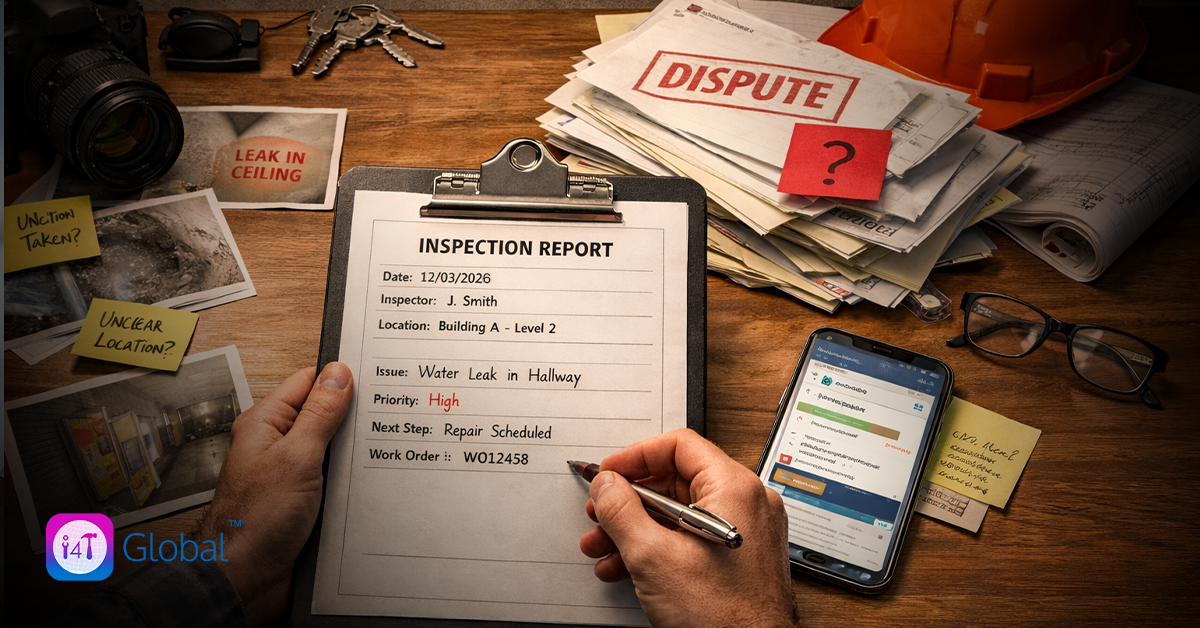
AI is turning up in strata maintenance in a pretty predictable way. First, it helps with the boring admin. Then it starts writing things for you. Then someone asks it to “just generate the report” and suddenly you’re wondering whether you can rely on what it produced.
Used well, AI can take hours out of your week and make your service feel more responsive without you living in your inbox. Used poorly, it can create new risks around privacy, compliance, and documentation that’s meant to stand up in front of a committee, an insurer, or a tribunal.
This guide is for Australian strata managers who want the practical upside without stepping on landmines. We’ll look at real AI in strata maintenance use cases, where AI for predictive maintenance in strata buildings makes sense, and the main risk areas to treat as human-only territory.
What counts as AI in strata maintenance, and why does it matter?
In strata maintenance, “AI” usually shows up in three forms:
Automation and routing: tools that categorise requests, assign priorities, and move tasks along a workflow.
Analytics and prediction: tools that find patterns in work orders and asset history, then suggest what might fail next.
Generative AI: tools that draft text, summarise notes, generate reports, and create resident updates.
The reason it matters is simple: the more the tool is creating content or recommending decisions, the higher the risk if it’s wrong. Automating a reminder is low-stakes. Drafting a safety-related update, interpreting an inspection note, or producing an “official” maintenance report is a very different level of responsibility.
A helpful way to think about it is this: AI can be excellent at organising information you already have. It’s far less reliable when it has to guess what’s missing, or when it’s asked to make judgment calls without full context.
What are the safest AI in strata maintenance use cases to start with?
If you’re looking for quick wins, start where AI is basically acting like an assistant that speeds up admin, not an expert that replaces professional judgment. These are the safest AI in strata maintenance use cases because they’re easy to check and easy to reverse if needed.
A few examples that tend to work well:
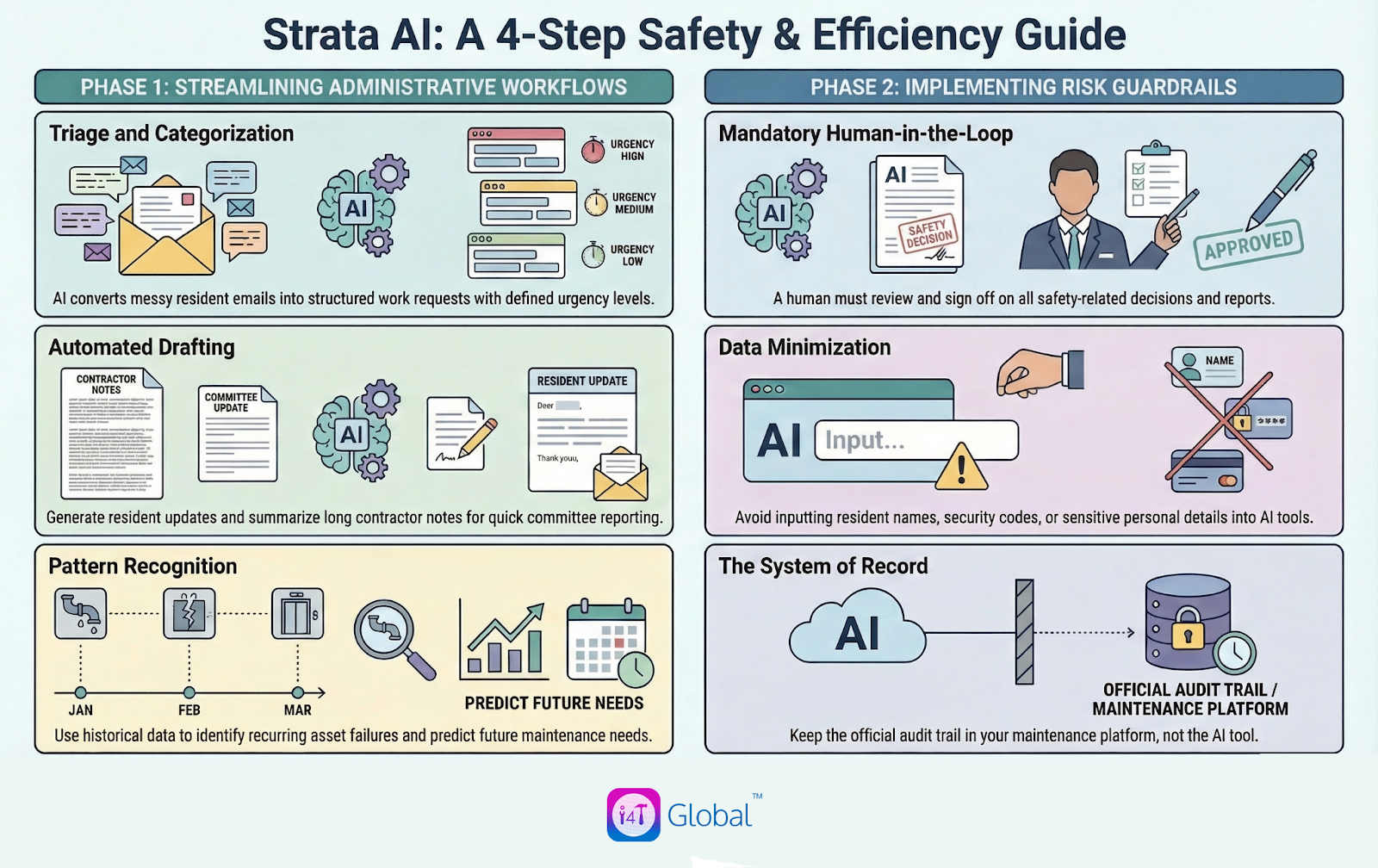
- Triage and categorisation: turning a messy email into a structured work request with the right category, location, and urgency.
- Drafting resident updates: creating a clear status message you can review and send.
- Summarising job notes: converting long contractor notes into a short summary for committee reporting.
- Finding history fast: pulling up previous work orders for the same asset or recurring issue.
- Follow-up prompts: reminding your team when a job has been sitting too long without an update.
The “safe” theme here is that AI output is supporting your process. It isn’t making the final call, and it isn’t becoming the official record without review
Where does AI save the most time in the work order lifecycle?
Strata maintenance is full of small time drains. Not huge tasks, just constant context switching.
AI saves the most time in the handover moments: when a request becomes a work order, when a work order becomes a contractor booking, and when a job becomes an update to residents and the committee.
Here’s what that looks like in practice.
Logging requests cleanly. Residents rarely report issues in a neat format. AI can help turn “the thing in the hallway is making a weird noise again” into a proper job record with a location, asset type, and symptoms. Your team still confirms details, but you start from a cleaner baseline.
Prioritising consistently. When you’ve got ten jobs waiting, AI can suggest a priority based on patterns you set, such as safety, access, water ingress, lift outages, or repeat failures. The key is that you define the rules and escalation triggers. AI is just applying them.
Reducing chasing. One of the biggest complaints drivers is silence. AI can propose a short update cadence and draft the messages so residents don’t feel ignored. You can also use it to flag jobs that haven’t moved and need someone to nudge the contractor.
Reporting without the scramble. Monthly committee packs are often a last-minute rush. AI can summarise the month’s work orders, highlight repeat issues, and propose a simple narrative. The time saving is real, as long as you treat it as a draft and validate the facts.
Can AI help with scoping and quote comparisons without creating blow-ups?
Yes, but only if you treat AI as a scope organiser, not a scope author.
The most common strata quote problems aren’t about price. They’re about a scope mismatch. One contractor includes access equipment, another assumes it’s provided. One includes making good, another doesn’t. One includes after-hours work, another excludes it. Then the committee compares numbers that were never comparable.
AI can help in three useful ways:
Drafting a clearer scope template. If you already have standards for what must be included, AI can turn that into a clean scope of work template fast. This reduces the back-and-forth that wastes time.
Highlighting gaps and assumptions. When you feed it the inclusions and exclusions, AI can flag likely mismatch areas, like access, disposal, isolations, certifications, warranties, and making good. You still need a human to confirm site realities, but it’s a strong first pass.
Standardising quote summaries. AI can produce a structured comparison page so committees can see what they’re actually approving.
The risk is when AI is asked to invent missing details. If the scope is unclear, AI may fill in the blanks with something that sounds reasonable but isn’t correct. That can lead to disputes, variations, and reputational damage.
A simple rule that helps: AI can reformat and compare. Humans confirm and approve.
What does AI for predictive maintenance in strata buildings actually mean?
This is where expectations can get weird, so let’s keep it grounded.
AI for predictive maintenance in strata buildings is about using patterns in your data to estimate which assets are likely to fail, and when maintenance might prevent downtime. It’s not a crystal ball. It’s a probability tool that improves with good inputs.
It works best when you have:
- a consistent asset register
- a solid history of work orders and contractor notes
- inspection results recorded in a structured way
- repeatable assets like lifts, pumps, HVAC, garage doors, hot water systems, access control
In plain terms, predictive maintenance helps you spot things like:
- a pump that’s needing callouts more often than similar pumps
- an aircon unit with a pattern of high-cost repairs that suggests end-of-life
- a building with recurring water ingress in the same zone after heavy rain
- a lift that is trending toward failures that usually precede a major outage
Where it adds value for strata managers is in committee conversations. Instead of “we should do this because it feels prudent”, you can say “here’s what’s been happening, here’s the risk pattern, and here’s the likely cost of doing nothing”.
The limitation is that strata buildings are full of one-off situations. A roof leak caused by a storm event doesn’t behave like a lift motor with known failure cycles. Predictive works best on assets and issues that repeat.
What data do you need for AI, and what data should you avoid?
AI doesn’t magically fix messy records. If your maintenance history is inconsistent, AI will simply summarise inconsistently.
The best-performing AI workflows are built on structured, boring data:
- work orders with clear categories and locations
- time-to-respond and time-to-complete fields
- contractor attendance dates and outcomes
- photos attached to jobs with basic labels
- asset registers that link jobs to equipment
- inspection results captured in consistent formats
The bigger risk is personal information. Australian privacy expectations apply when AI tools handle personal information, and the OAIC has specifically published guidance aimed at helping organisations comply with their privacy obligations when using commercially available AI products.
So keep it simple: don’t feed AI more personal details than it needs.
Here’s a practical “safe input” approach:
- Do include: job details, asset references, technical notes, and inspection outcomes.
- Avoid where possible: resident names, phone numbers, sensitive complaint details, access codes, security specifics, and anything that could identify a person unnecessarily.
If you need to use resident details for communications, do it inside systems designed for property operations and access control, not in random chat tools.
What is the real AI risk in strata building maintenance compliance?
The biggest AI risk in strata building maintenance compliance is not that AI is malicious. It’s that AI can be confidently wrong, and people can accidentally treat its output as authoritative.
In strata, compliance risk tends to spike in three situations.
Safety and urgency decisions. If AI suggests a job is low priority and it’s actually a safety issue, the consequences can be serious. Even if AI helped you sort the queue, the responsibility to manage risks doesn’t disappear.
Record keeping and audit trails. Strata management lives and dies by documentation. If an AI-generated job note or report is wrong, vague, or misleading, it can create problems later when decisions are questioned.
Communication that implies certainty. Residents and committees often read updates as commitments. If AI drafts a message that over-promises a timeline or downplays the risk, you can end up with more complaints, not fewer.
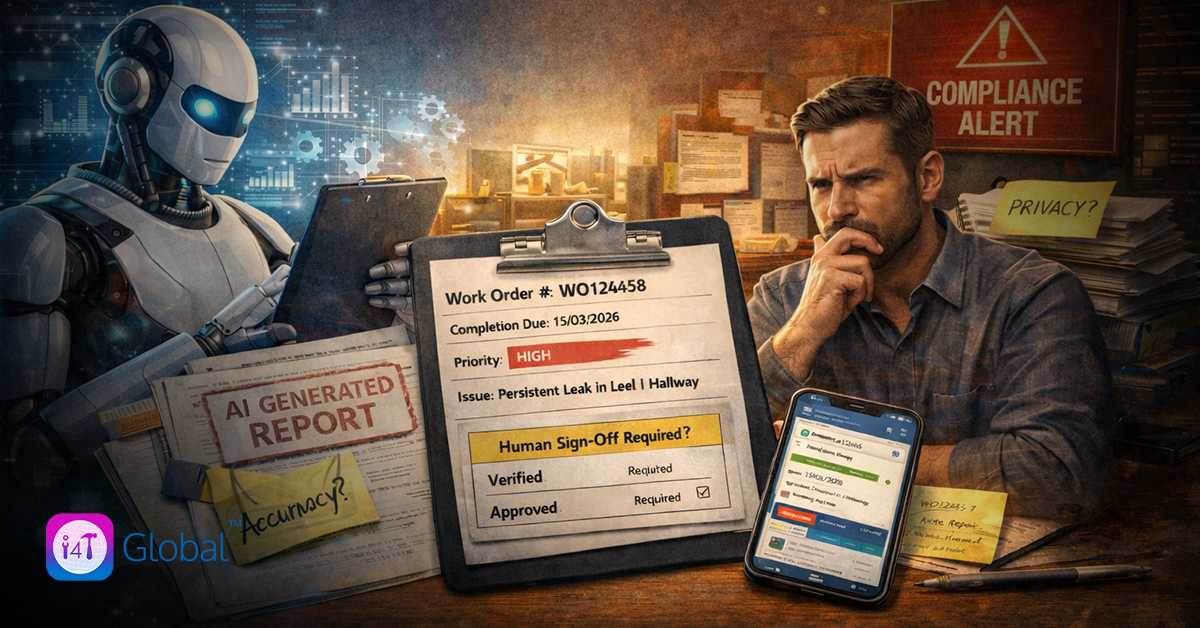
This is why “human-in-the-loop” isn’t a buzzword. It’s a practical control that keeps AI as a support layer, not the decision-maker.
What is the AI-generated maintenance reports legal risk in Australia?
This is the point where AI can be most tempting and most dangerous.
The phrase AI-generated maintenance reports legal risk Australia basically comes down to this: if a report is relied on to make decisions, it needs to be accurate, defensible, and properly sourced.
In real strata life, maintenance reports get used for:
- committee decisions and approvals
- budgeting and capital works planning
- insurance claims support
- disputes with contractors
- disputes between owners and the owners corporation
- documenting patterns of repeated failure or rectification
If AI generates a report that contains factual errors, missing context, or assumptions presented as facts, it can create legal and commercial exposure. Not because AI is special, but because the report becomes part of the record and can be relied upon by others.
A safe approach is to separate:
Observed facts: dates, photos, contractor attendance, inspection outcomes, invoices.
Interpretation: causes, liability, risk levels, recommended remedies.
AI can help format and summarise the facts, as long as those facts are pulled from your system of record. Interpretation should remain human-led, and where it crosses into technical or legal territory, it’s worth involving the right professional.
Also, keep your drafts clear. If AI has drafted a report, label it internally as a draft until reviewed. Make it easy to see what was verified and what was generated.
How do you reduce privacy and security risks when using AI tools?
This is where policy beats cleverness.
The OAIC’s guidance is a strong reminder that organisations should think carefully about privacy obligations when using commercially available AI products. That matters in strata because maintenance often includes personal information, schedules, access arrangements, and resident communications.
A practical, low-fuss way to reduce risk is to implement a simple “AI usage standard” for your team:
- Use approved tools only
- Keep personal information to a minimum
- Don’t paste access codes, security details, or sensitive complaints into generic AI tools
- Store the official record in your maintenance system, not in the AI tool
- Keep permissions tight so only relevant staff can access job data
Another helpful lens is Australia’s AI Ethics Principles, which highlight themes like privacy protection, transparency, and reliability. You don’t need to run a big program to benefit from that. You can translate it into everyday rules: be clear when content is AI-assisted, verify before sending, and make sure the system behaves reliably for its intended purpose.
What guardrails make AI genuinely useful without creating risk?
Guardrails don’t need to be heavy. They need to be clear.
One of the best habits you can build is to split your workflows into two categories:
Category A: AI-friendly admin
Drafting, summarising, categorising, comparing, formatting.
Category B: Human-only judgement
Safety decisions, compliance interpretations, final reports, and anything that could be relied upon in a dispute.
A simple set of guardrails that works well in strata maintenance looks like this:
- Define approved use cases. Be explicit about where AI is allowed and where it isn’t.
- Require human sign-off for resident communications, committee reporting, and anything safety-related.
- Use structured templates so AI isn’t guessing what belongs in a scope, update, or report.
- Keep an audit trail. Make sure the source of truth is your maintenance platform and job history.
- Have escalation rules for safety. If something involves electrical hazards, water near electrical, fire safety systems, structural concerns, or access risks, it bypasses AI prioritisation and goes straight to human assessment.
- Do small spot checks. Every week, review a sample of AI-assisted outputs to catch drift.
AI works best on structure, not guesswork
AI can genuinely improve strata maintenance operations when it’s used to reduce admin friction, keep communication consistent, and surface patterns in your maintenance history. It can help you move faster without dropping balls, and it can make your service feel calmer and more organised to residents and committees.
The risk rises sharply when AI is asked to make judgement calls, handle personal information carelessly, or produce “official” documentation without careful review. If you treat AI as a draft machine and a pattern spotter, and keep humans responsible for decisions, you get the upside without inviting trouble.
i4T Maintenance – Maintenance Management Software provides the right ground for AI workflows in strata maintenance because it keeps your work orders, assets, history, and communications structured and searchable. When your data is clean and your process is consistent, AI becomes a safe accelerator rather than a risky shortcut.
FAQs
Yes, especially for admin tasks like sorting requests, drafting updates, and summarising job notes. It saves time when you still review the final output.
Triage and categorisation, follow-up reminders, drafting resident updates, and creating draft committee summaries from work order data.
No. It can help organise information, but it can’t replace site inspections, technical judgement, or compliance decisions.
Over-relying on AI outputs for safety or compliance decisions, especially if the AI is missing context or “fills in” assumptions.
Use AI reports as drafts only, verify facts against your system records, keep an audit trail, and have a human sign off before sharing with committees or owners.
Hot off the press!

Field Service Management sector operates, the i4TGlobal Team loves to share industry insights to help streamline your business processes and generate new leads. We are driven by innovation and are passionate about delivering solutions that are transparent, compliant, efficient and safe for all stakeholders and across all touch points.
Recent articles that may interest you as well..