If you run a field service business in Australia, you already know the work itself is only half the battle. The other half happens in the cracks between jobs: answering new enquiries while you’re on-site, chasing quotes that went quiet, confirming bookings, preventing no-shows, and remembering to follow up with past customers before they call someone else.
In 2026, that “between jobs” admin is where a lot of revenue is either won or quietly lost.
That’s why marketing automation has become such a big deal for tradies and field service teams, as a practical way to keep your pipeline moving even when you’re flat out.
The key is doing it in a way that feels human. Customers don’t want to be blasted. They want to be looked after. They want the next step to be easy.
Behaviour-based automation does exactly that. Instead of sending generic campaigns on a schedule, you trigger messages based on what the customer actually does, or doesn’t do, like submitting an enquiry, viewing a quote, missing a call, booking a job, or going quiet for months.
And when it’s set up properly, it doesn’t just save admin time. It lifts conversions. It turns “maybe” leads into booked jobs, reduces ghosting, and brings past customers back in without awkward “Heyyyy just checking in” vibes.
Why field-service marketing automation looks different in 2026
The biggest shift in 2026 isn’t that customers have suddenly become “harder”. It’s that they’ve become quicker.
People fire off enquiries in seconds, often to multiple businesses, and then they go with the one that replies first and makes the process simple.
They’re not always chasing the cheapest option; they’re chasing certainty. “Can you do it?” “When can you come?” “What happens next?” The business that answers those questions fastest usually wins.
On top of that, customers are spread across channels. Some love email. Others won’t read an email but will reply instantly to a message. Some will call once, and if you miss it, they’ll never call again.
So relying on one channel and one style of follow-up is risky.
Behaviour-based automation is basically the antidote to all of that. It’s the difference between “just quoting” and “quoting and automatically following up”.
It’s also what helps smaller teams compete with bigger operators. You don’t need a full-time admin person chasing people all day; you need a system that nudges the right customer at the right time, with the right message.
In 2026, the winning formula is simple: Speed, Relevance, and Next Step.
Set the foundation first: map your pipeline before you automate
Automation doesn’t fix a messy pipeline; it multiplies it.
If your leads and customers aren’t clearly organised, your automation will end up doing weird stuff. Like sending a “still want that quote?” message to someone who already booked. Or pushing a reminder to a customer you’ve marked as lost. That’s the kind of thing that makes automation feel robotic and embarrassing.
So before you build any flows, make sure your pipeline stages reflect reality. Keep it practical, not perfect. Most field service businesses can run with a simple set of stages that everyone understands at a glance.
Then you decide what behaviours matter. These behaviours become your triggers; the “if this happens, then do that” rules that keep your pipeline moving without you constantly thinking about it.
A good way to approach this is to imagine the customer journey like a series of tiny decisions. Every step has a moment where the customer can either move forward… or drift away. Behaviour-based automation is just a set of prompts that help them move forward.
| Common Pipeline Stages | Behaviours to Trigger |
|---|---|
| New lead | New enquiry submitted/new lead created |
| Contacted | Missed call |
| Qualified | Quote sent |
| Quote sent | Quote viewed/Not viewed |
| Follow-up due | No response after X time |
| Won | Appointment booked/Rescheduled |
| Job Completed | Service Delivered |
| Paid | Invoice Paid |
| Lost | No activity for 6–12 months |
Reach customers where they are
A lot of businesses get automation wrong because they treat it like “more marketing”. But the best automation in field services feels like customer service. It’s timely, helpful, and it reduces effort for the customer.
Think about what your customer wants in the moment:
- When they enquire: they want reassurance you’re real, and a quick path to booking.
- When they receive a quote: they want clarity, and sometimes a nudge to decide.
- When they’ve booked: they want reminders so life doesn’t get in the way.
- After the job: they want closure, and a simple way to share feedback if they’re happy.
Different channels suit different moments. Quick messaging is great for confirmations, reminders, and short back-and-forth. Email is great for anything detailed, like quotes, options, photos, and “here’s what’s included” explanations.
The point isn’t to use every channel. The point is to use the one that makes the next step easiest.
Also, keep your tone friendly and local. Australians respond well to direct, no-nonsense communication — not fluffy marketing language. A short, clear message that respects their time will beat a long “salesy” one almost every time.
Behaviour-based flows that win jobs
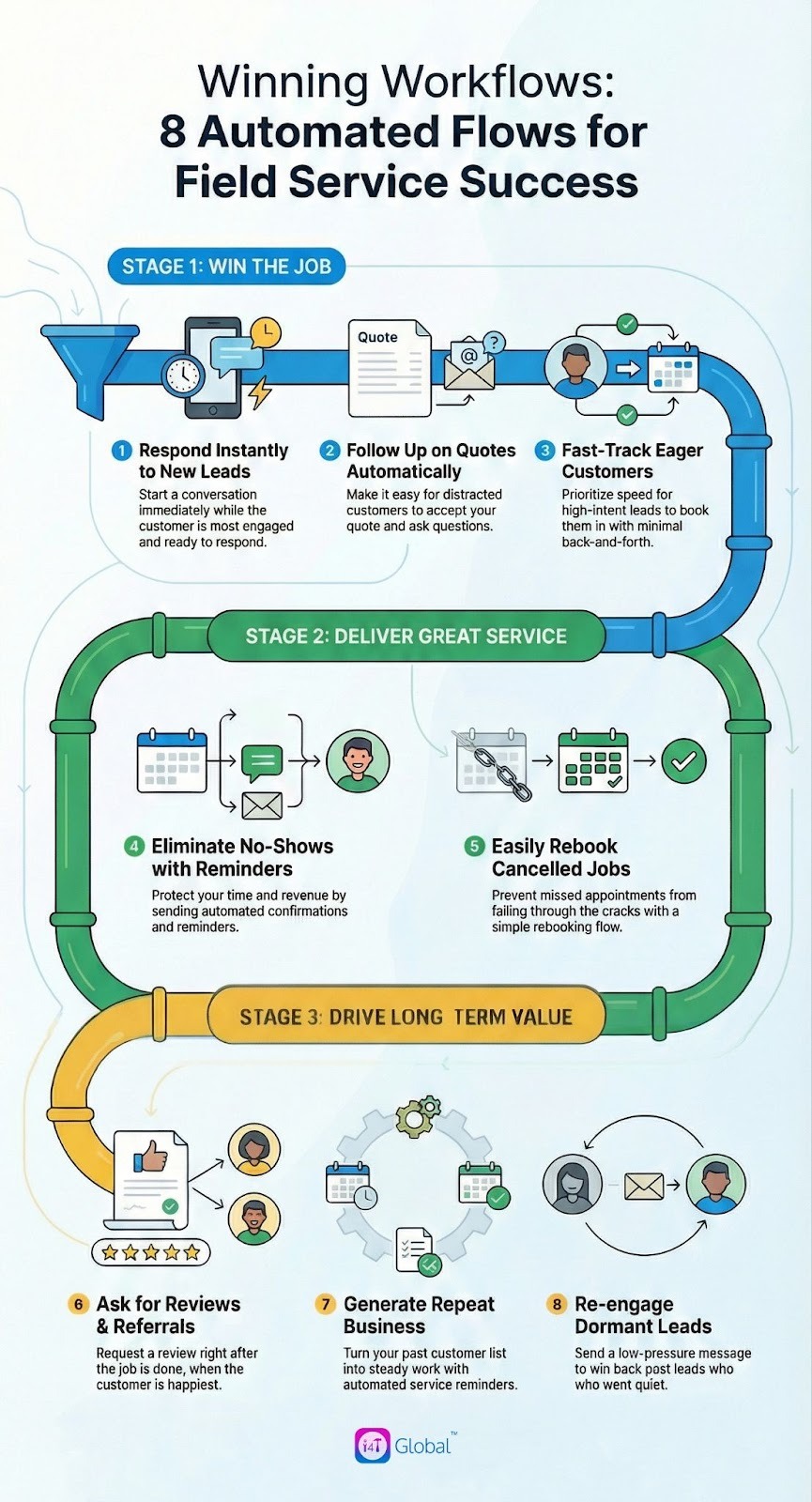
This is the fun part – the flows that actually move the needle. The trick is to build them like you’d follow up naturally on a good week… and then make it consistent even on your busiest week.
Below are the most reliable behaviour-based flows for field services.
Flow 1: Speed-to-lead
When a new enquiry comes in, there’s a tiny window where the customer is most engaged. They’re holding their phone, they’re actively trying to solve a problem, and they’re ready to respond. If they don’t hear from you, they’ll assume you’re busy, or unreliable, and they’ll move on.
The goal here isn’t to “sell”. It’s to start a conversation and reduce friction. You’re basically saying: “Yep, we can help. Here’s the quickest way to get you sorted.”
What it looks like:
- Trigger: new lead created or missed call
- Message idea: quick acknowledgement + one question (address / best time / photo)
- Timing: immediate, then a gentle follow-up if no reply
- Measure: time to first response, reply rate, booking rate
Flow 2: Quote follow-up
Quotes often die for boring reasons: the customer got distracted, the email got buried, they weren’t sure about one item, or they wanted to ask a question but didn’t want the hassle. Most people don’t ghost because they hate you; they ghost because deciding feels like work.
So your follow-up needs to make the decision easier. Instead of just checking, give them a simple path: “Want me to explain it?” “Do you want option A or B?” “Do you want to lock it in for next week?”
Also, branching matters. If someone hasn’t even opened the quote, your follow-up should be about delivery. If they opened it and didn’t accept, your follow-up should be about building confidence.
What it looks like:
- Trigger: quote sent
- Branching: viewed vs not viewed
- Sequence: 24 hours → 3 days → 7 days (last nudge)
- Measure: quote acceptance rate, time-to-accept, drop-off points
Flow 3: Hot lead acceleration
Some leads give off obvious buying signals. They reply quickly. They click links. They ask you to come. Those leads don’t need more information; they need momentum.
If you slow them down with extra back-and-forth, you can lose them to someone who simply offered two time options and booked them in.
A hot lead flow is about prioritising speed and certainty. You’re helping them commit by making the decision feel easy and low-effort.
What it looks like:
- Trigger: multiple engagements, fast replies, high-intent questions
- Message idea: offer two booking windows (
- Goal: faster booking, fewer messages to close
- Measure: enquiry-to-booking time, conversion rate for “hot” segment
Flow 4: Appointment reminders
No-shows are brutal because they waste the one thing you can’t get back: time. And in field services, time equals money. Reminders aren’t just admin; they’re revenue protection.
Good reminders don’t nag. They reassure. They confirm details. They give customers an easy way to reschedule without feeling awkward.
When people can reschedule easily, they’re less likely to ghost.
What it looks like:
- Trigger: appointment booked
- Sequence: day before confirmation → morning of reminder → optional “on my way”
- Include: time, address, access notes, and an easy reschedule line
- Measure: no-show rate, reschedule rate, wasted hours saved
Flow 5: Reschedule recovery
Even with reminders, life happens. Kids get sick. Work meetings run late. Customers forget. The mistake is letting a cancelled or missed appointment fall into a black hole.
A reschedule recovery flow simply keeps the relationship warm and gets the job back on the calendar quickly. The tone matters here: friendly. You want to make it easy for them to say yes again.
What it looks like:
- Trigger: cancelled appointment, failed access, no confirmation
- Message idea: “Want to rebook for later this week or next?”
- Goal: rebook quickly, reduce churn
- Measure: rebook rate, time-to-rebook
Flow 6: Job complete
Right after a job is completed or paid, is the best time to ask for a review. The customer has just felt the relief of the problem being solved. If they’re happy, they’re most willing to help.
Reviews aren’t just a vanity metric. They’re a conversion tool. They help future customers trust you faster. Referrals are even better; they typically convert at a higher rate and with less price-shopping.
The key is to keep the request simple, polite, and low-effort. You’re not begging. You’re giving them a quick way to support a small business.
What it looks like:
- Trigger: job completed or invoice paid
- Sequence: same day request → 3-day gentle nudge if needed
- Optional: a friendly referral prompt
- Measure: review rate, referral leads, conversion rate from referrals
Flow 7: Repeat work and maintenance reminders
The easiest customer to book is someone who already trusts you. Yet heaps of field service businesses rely almost entirely on new leads, which are more expensive and harder to convert.
A repeat-work flow turns your past customer list into a steady source of bookings. It’s basically: “Hey, it’s been a while, and this thing usually needs attention around now. Want to get ahead of it?”
What it looks like:
- Trigger: time since last job (based on service type)
- Message idea: service reminder + easy booking option
- Goal: increase repeat bookings, smooth out seasonal dips
- Measure: repeat booking rate, customer lifetime value
Flow 8: Win-back / reactivation
Not every lead that goes quiet is a lost cause. People get busy. Budgets change. Other priorities pop up.
A win-back flow is a friendly tap on the shoulder that reopens the conversation without pressure.
You don’t have to discount to win people back. Often, all you need is a well-timed message and an easy path to rebook.
What it looks like:
- Trigger: no activity for 6–12 months
- Tone: casual, helpful, low-pressure
- Goal: replies and rebookings from dormant contacts
Measure: reactivation reply rate, booking rate from dormant segment
How to make automation feel personal
Segmentation sounds like marketing jargon, but it’s really just common sense: different people need different messages. A residential customer with an urgent leak needs a different follow-up to a commercial client reviewing a larger quote.
If you don’t segment, you end up sending generic messages that feel irrelevant. If you do segment, even slightly, your automation starts feeling like you’re paying attention.
Start small. You don’t need 50 segments. A handful will do:
- Split by customer type
- Split by job type
- Split by lead status
- Split by behaviour (engaged recently vs gone quiet)
Filters, on the other hand, are the safety rails. They stop you from messaging people who shouldn’t be messaged, and they keep your communication clean.
High-impact segments to start with:
- Residential vs commercial/strata
- Emergency vs planned work
- New leads vs quoting vs booked vs dormant
- Engaged in the last 14 days vs not engaged
Filters that prevent awkward mistakes:
- Exclude anyone already booked
- Exclude anyone marked lost
- Only send follow-ups during reasonable hours
- Prioritise leads inside your service area
How to execute the campaign
The best automation systems don’t rely on you remembering things. They rely on templates and routines.
Build a small library of templates you actually use. Keep them short. Keep them friendly. Keep the next step obvious.
And write like a real person. A message that sounds like a human tradie will outperform a message that sounds like it was written by a marketing department.
A practical “message library” to build once and reuse:
- New lead acknowledgement
- Quote follow-up
- Booking confirmation
- Reminder
- Reschedule prompt
- Review request
- Maintenance reminder
- Win-back message
Make sure to keep your template short and scannable, add just one clear next step, and keep it friendly.
Measuring campaign results
It’s tempting to obsess over opens and clicks. They’re nice, but they’re not the point. In field services, the metrics that matter are the ones tied to bookings and revenue.
When you look at performance, think like this: “Where do we lose people, and what small change could reduce that?”
If quotes aren’t being accepted, it might not be your price, it might be a lack of follow-up consistency. If you’re getting leads but not bookings, it might be your response time. If you’re busy but cashflow is lumpy, it might be a lack of repeat work reminders.
Start with a weekly check-in. Thirty minutes. Same day every week. You’ll be shocked how quickly this compounds.
Metrics worth watching weekly:
- Speed-to-lead
- Reply rate
- Booking rate
- Quote acceptance rate
- No-show rate
- Repeat booking rate
- Review and referral conversions
Simple optimisation can help here. Change one thing at a time, keep what improves outcomes, and bin what doesn’t.
Making offline campaigns measurable
Flyers, signage, local sponsorships, and community events still work in Australia, especially for suburban services. The problem is that most businesses can’t tell what’s actually paying off, so they either overspend blindly or stop doing offline altogether.
In 2026, offline works best when you track it like online. Give each campaign a way to identify itself so you can attribute leads and jobs properly. That way, you can make decisions based on reality, not vibes.
Offline campaigns that are common in field services:
- Letterbox drops
- Local club sponsorships
- Ute signage
- Community events and expos
- Referral partnerships
To make these measurable, use unique QR codes or short links per campaign, add campaign tags on incoming leads, and track budget so you can calculate ROI.
Turn follow-up into a system
Behaviour-based marketing automation in 2026 isn’t about sending more messages. It’s about sending the right message at the right time, so customers don’t fall through the cracks when you’re busy doing the actual work.
When your follow-up becomes a system, you stop relying on memory and luck.
Quotes get chased consistently. Bookings get confirmed. No-shows drop. Past customers come back. And you get more predictable revenue without adding more admin to your day.
If you want a CRM built for Australian tradies that helps you run behaviour-based marketing automation, including cross-channel campaigns, automated workflows triggered by behaviour/status/timing, segmentation and filtering, and clear analytics; i4T CRM is built for exactly that. If you’re keen to see how it could work for your business, book a demo of i4T CRM and we’ll walk you through setting up the highest-impact flows first.
Hot off the press!

Field Service Management sector operates, the i4TGlobal Team loves to share industry insights to help streamline your business processes and generate new leads. We are driven by innovation and are passionate about delivering solutions that are transparent, compliant, efficient and safe for all stakeholders and across all touch points.
Recent articles that may interest you as well..