TL;DR
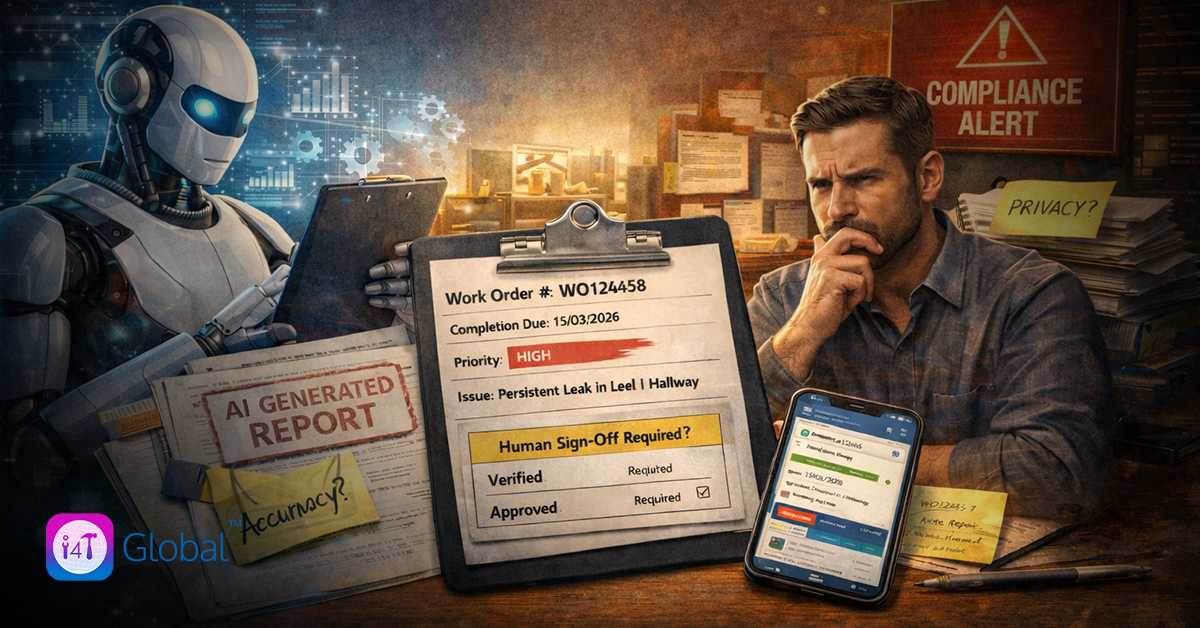
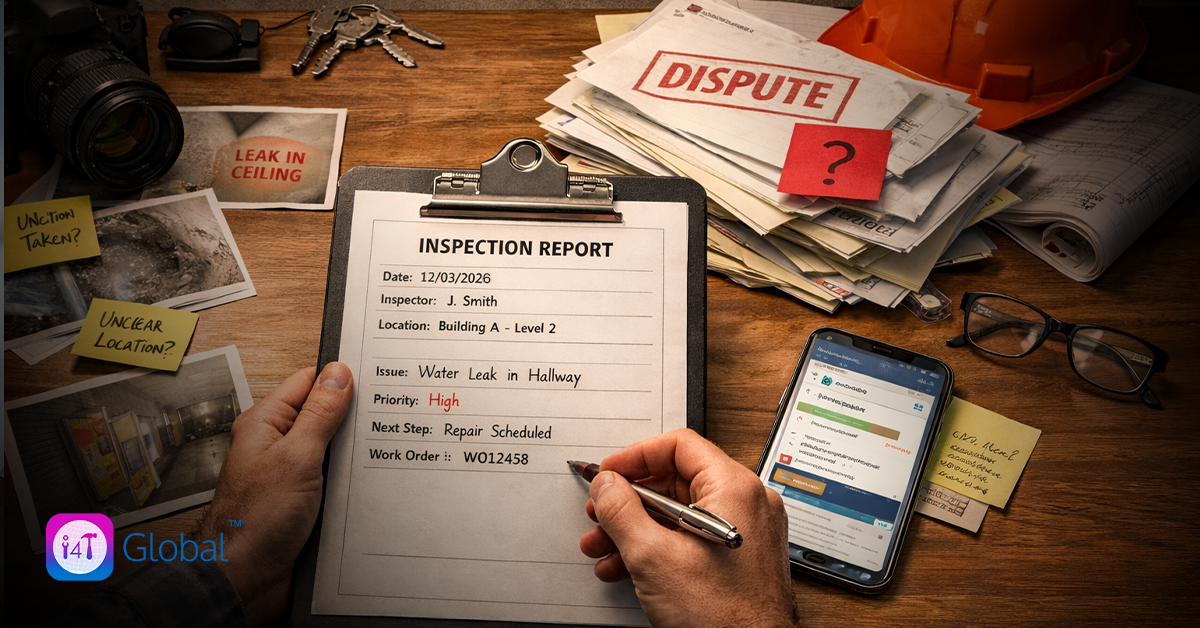
Most inspection mistakes causing strata disputes come down to unclear records: vague notes, unlabelled photos, missing timelines, and inspection findings that never turn into tracked work orders.
To prevent disputes, follow strata inspection record-keeping best practice by:
- Recording the who, when, and where
- Adding clear wide and close-up photos
- Assigning a priority and next step
- Linking every finding to a work order with a due date and closure proof
When everyone can see the same inspection history in one place, complaints drop, follow-ups reduce, and decisions are much easier to explain.
Inspections are meant to keep common property safe, functional and well-maintained. But in strata, inspections can also be the spark that starts an argument that drags on for weeks. Not because anyone set out to be difficult, but because the record of what happened is unclear.
Most inspection mistakes causing strata disputes are boring ones: a note that is too vague, a photo that can’t be matched to a location, a defect that was spotted but never turned into a work order, or an inspection report that lives in someone’s inbox where nobody else can find it.
The good news is that you don’t need a complicated process to fix this. You need a repeatable, consistent strata inspection record-keeping best practice. That means capturing the right details every time, linking findings to follow-ups, and keeping a clean timeline you can point to when questions come up.
What inspection mistakes most commonly trigger strata disputes?
Disputes usually happen when people feel surprised, ignored, or unconvinced. Inspections can create all three.
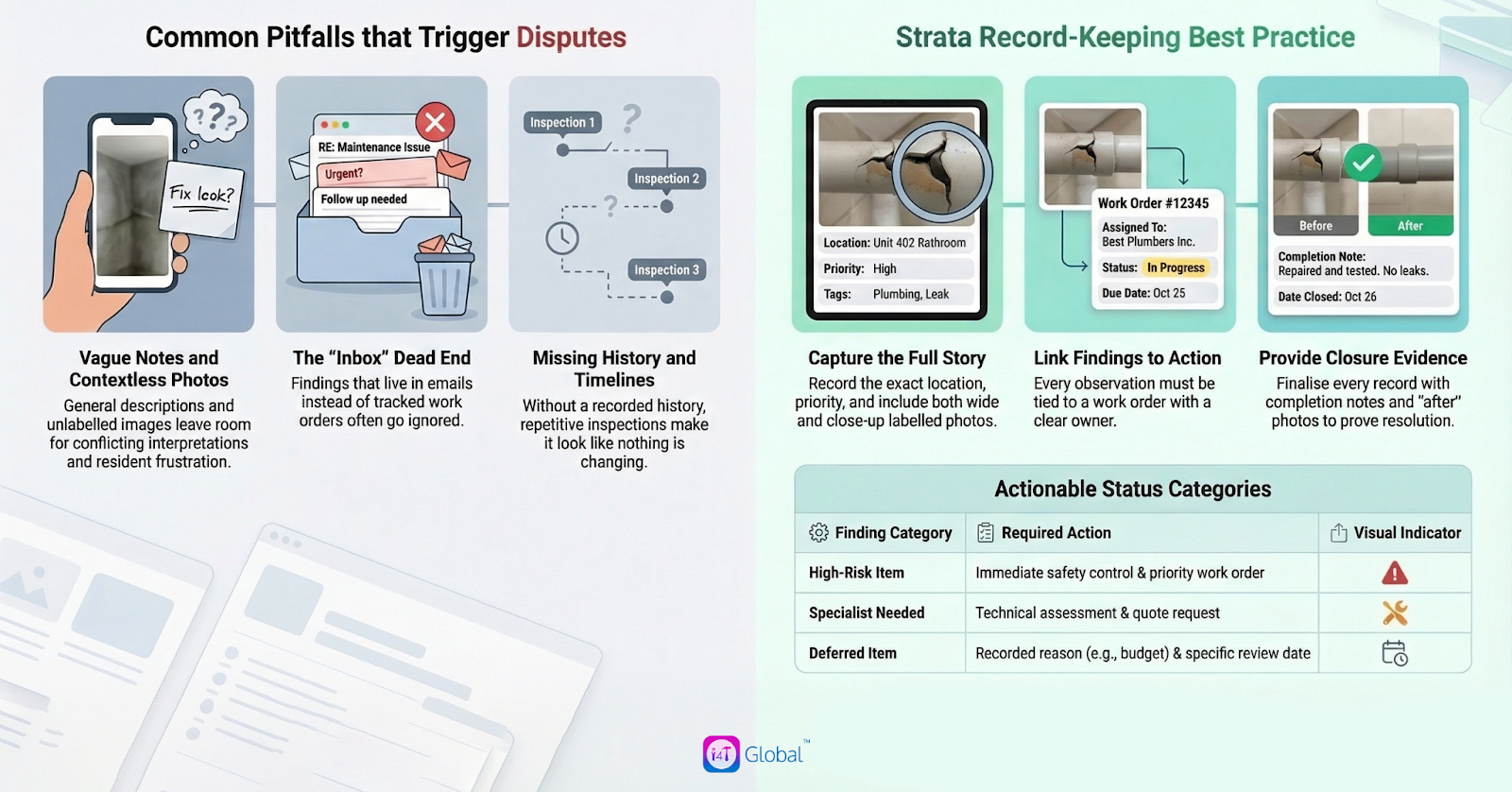
Here are the common culprits:
- The inspection is done quickly, and the notes are too general to act on later.
- Issues are recorded, but there’s no clear priority or next step.
- Photos exist, but there’s no context: where is this, how big is it, what are we looking at?
- The inspection identifies a risk item, but no temporary control is recorded, so residents think nothing happened.
- Findings are not shared consistently with the committee, building manager, or relevant residents.
- The inspection is repeated, but the history is missing, so it looks like nothing is changing.
When records are thin, people fill the gap with assumptions. That’s when a maintenance discussion turns into a dispute about responsibility, timing, cost, or duty of care.
What should a good strata inspection record include?
A strong inspection record does two jobs at once. It tells the story of what was seen, and it makes it easy to take action.
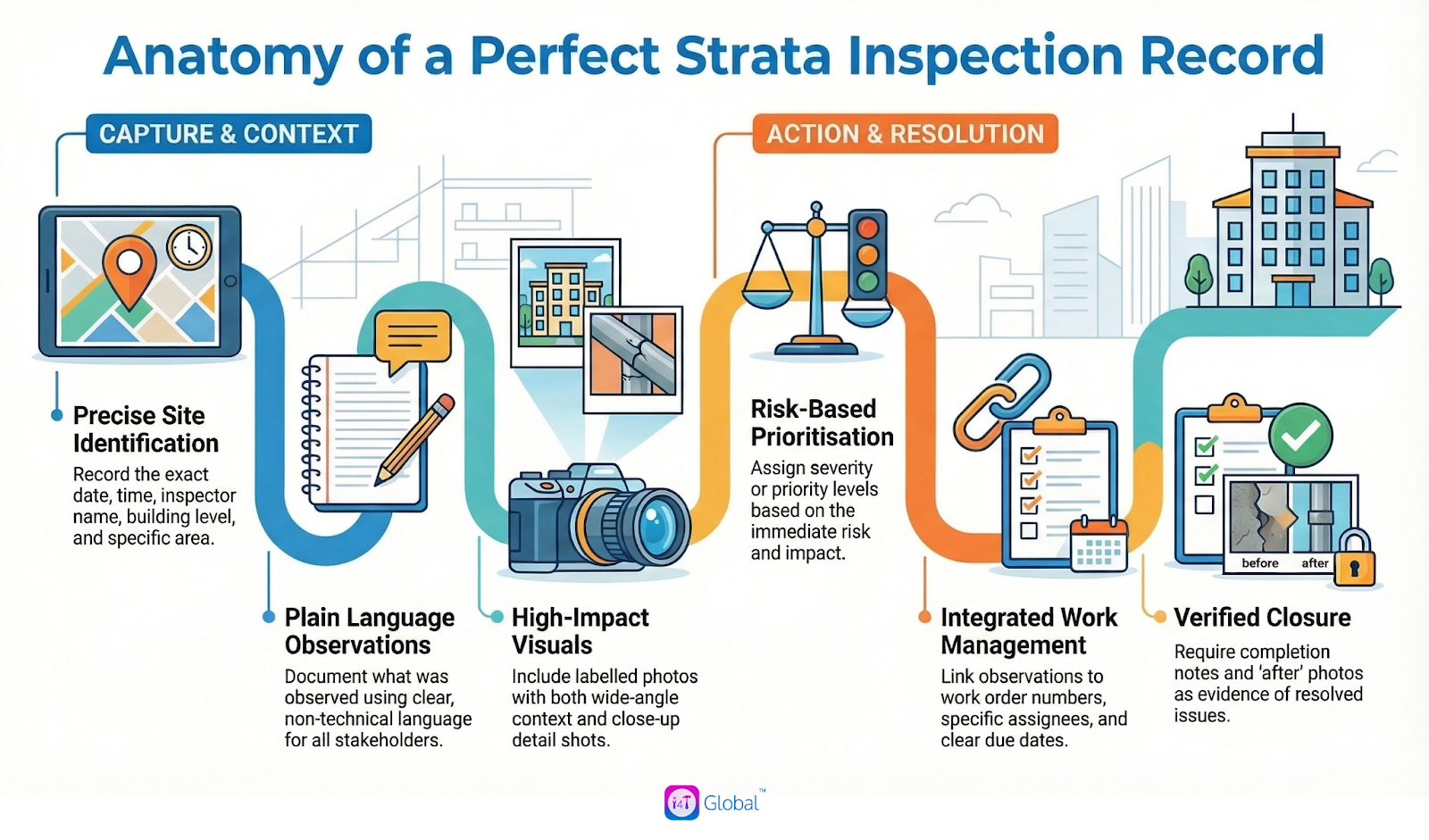
A practical inspection record usually includes:
- Date and time, and who completed the inspection
- Exact location, including building, level, and area
- What was observed, written in plain language
- Severity or priority, based on risk and impact
- Photos with clear labels, plus a wide shot and a close-up where possible
- Immediate safety actions taken, if relevant
- Recommended action and who it’s assigned to
- A linked work order number, due date, and status
- Closure evidence, such as a completion note and after photos
This is the heart of strata inspection record-keeping best practice: not perfect writing, just consistent detail that anyone can understand later, even if the people involved have changed
How do poor records turn small defects into bigger disputes?
In strata, it’s rarely the original defect that creates the mess. It’s the uncertainty around what happened next.
Here’s how it usually plays out:
A minor crack, leak, or worn fitting is spotted. Someone notes it down. A few weeks later, a resident follows up. The committee asks what was found. The strata manager searches for the details. The note is brief, the photo is unclear, and there’s no linked work order. Now the question becomes: did we know about this, and did we respond properly?
That shift matters. Once the conversation becomes about knowledge and response time, people get defensive. Residents feel dismissed. Committees feel blamed. Managers are stuck trying to reconstruct events from emails, texts, and half-finished reports.
Good records prevent this. They give you a clean timeline: when it was seen, how it was assessed, what was decided, and what was done.
How often should common property inspections happen?
There’s no single frequency that fits every building. A newer, low-rise scheme with minimal services will have different needs than a high-rise with lifts, fire systems, car stackers, pools, or an ongoing water ingress history.
What matters most is that you have a sensible schedule and can show that you follow it. Consistency is a quiet dispute-killer. When someone asks why an issue wasn’t picked up sooner, it helps to point to a regular inspection plan and a record trail that shows what was checked and when.
A practical way to think about it is:
- High-risk areas and high-use assets need more frequent checks
- Seasonal risks need seasonal attention, like stormwater before heavy rain periods
- Known recurring issues should be monitored until resolved
The schedule itself won’t stop every complaint, but it makes your decision-making easier to explain and defend.
Who should attend an inspection to avoid disagreements later?
Most routine inspections can be completed by one competent person, as long as the record is solid. Disputes tend to arise when the inspection is connected to a contentious issue: repeated complaints, potential liability, uncertain boundaries, or a big upcoming spend.
In those cases, having an extra set of eyes can reduce later disagreement. That might mean:
- The strata manager and a committee representative are attending together
- A building manager joining for access and context
- A specialist contractor attending for a technical assessment
The key is not the headcount, it’s the clarity. Record who attended, what areas were inspected, and what was agreed as the next steps. When residents or committee members change, that shared record becomes the anchor.
What’s the best way to use photos so they help, not confuse?
Photos are powerful, but only if they can be understood later. A blurry close-up without context often creates more follow-up questions than it solves.
A simple photo approach that works well:
- Start with a wide shot that shows the location
- Add a close-up that shows the defect clearly
- If size matters, include a visual reference, like a ruler or a common object
- Label photos with date and location
- If needed, add a short note describing what the photo shows and why it matters
Also, keep photos tied to the inspection record and the work order. When photos live in chat threads or personal phones, you lose the chain of evidence. That’s where confusions grow.
How do you record issues so responsibility is clearer?
A lot of strata disputes boil down to one question: is this lot property or common property responsibility?
While you can’t solve every boundary question with a template, better records make the conversation more factual and calmer. The record should clearly capture:
- The exact location of the defect, not just “outside unit 12”
- The building elements involved, like the ceiling, external wall, membrane, balcony, and pipework
- Any visible clues about the cause, such as a water staining pattern or recent weather events
- What was checked and what wasn’t, so people don’t assume more than the inspection covered
If it’s unclear, say so in the record. Uncertainty is fine. Hidden uncertainty is what causes trouble. When needed, record that a specialist assessment is required, then link it to the next action.
How do you stop inspection findings from going nowhere?
One of the most frustrating experiences for residents and committees is seeing the same issue appear in report after report with no visible progress.
This usually happens because inspections and work orders sit in different places. The inspection is completed, then the follow-up relies on someone manually creating tasks, chasing quotes, and remembering to update everyone.
A simple way to close the gap is to treat every inspection finding as a decision point:
- Fix now
- Monitor with a clear review date
- Quote required
- Specialist assessment required
- Defer with a recorded reason, such as budget timing or planned capital works
What reduces disputes is having that decision recorded and then tracked through to completion. If an issue is deferred, it’s not enough to just defer it. The record should show when it will be reviewed again and who owns the next step.
What do strata schemes need to keep on record, and why does it matter for disputes?
People often assume records exist and can be produced quickly.
For example, NSW guidance notes that owners corporations must keep records for seven years, and from 11 June 2024 certain required records must be kept digitally for new records created from that date.
Queensland guidance similarly explains that a body corporate must keep certain records, including financial records, correspondence, meeting minutes and material, and other official notices.
In WA, Landgate material describes strata company responsibilities that include record keeping, and also references arranging inspections of records under the Strata Titles Act.
You don’t need to turn your inspection process into a legal file. But you do want inspection records to be:
- Easy to find
- Consistent
- Linked to actions and outcomes
- Retained in a way that matches your local requirements
That’s what makes disputes easier to resolve and easier to prevent.
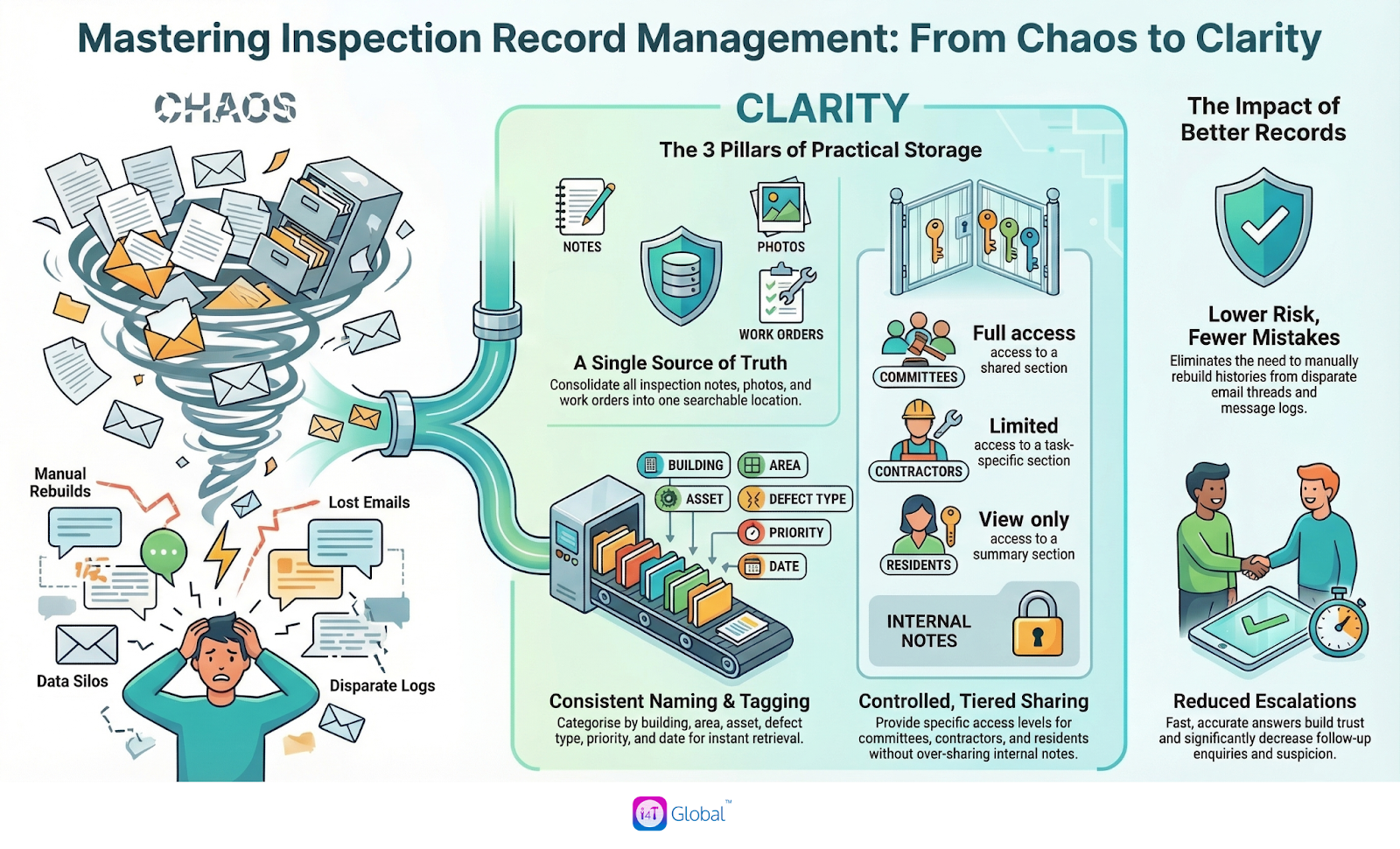
What’s the best way to store inspection records so they’re easy to find and share?
If you’ve ever tried to rebuild an inspection history from emails, PDFs, and message threads, you know the pain. It’s not just inefficient; it increases the risk of mistakes.
A practical storage approach has three qualities:
One place to look
A single source of truth where inspection notes, photos, and work orders live together.
A consistent structure
Naming and tagging that make retrieval easy: building, area, asset type, defect type, priority, and date.
Controlled sharing
The right people can access what they need without everything being forwarded around. Committees can see status and history. Contractors can see the scope and photos. Residents can receive clear updates without being flooded with internal notes.
When records are easy to retrieve, you can answer questions quickly and calmly. That alone reduces follow-ups, suspicion, and escalations.
A simple inspection record habit that prevents most disputes
If you only change one thing, make it this: every inspection item should have a clear next step and a clear owner. Even if the next step is “monitor and review on this date”.
That small habit creates transparency. Transparency reduces frustration. Less frustration means fewer disputes.
Better records make inspections feel fair
Strata is a people business as much as it is a building business. When inspection records are patchy, people assume the worst. When records are clear, consistent, and tied to actions, inspections feel fair, even when the answer is “not yet”.
If you want fewer back-and-forth emails, fewer repeat complaints, and fewer tense committee discussions, focus on strata inspection record-keeping best practice. Capture the details, attach the photos with context, link everything to work orders, and keep a clean timeline from inspection to closure.
i4T Maintenance – Maintenance Management Software helps you schedule inspection work orders, record findings on-site, attach photos and notes, assign follow-ups, and track completion in one place. That means you spend less time chasing details and more time keeping buildings running smoothly.
That small habit creates transparency. Transparency reduces frustration. Less frustration means fewer disputes.
Hot off the press!

Field Service Management sector operates, the i4TGlobal Team loves to share industry insights to help streamline your business processes and generate new leads. We are driven by innovation and are passionate about delivering solutions that are transparent, compliant, efficient and safe for all stakeholders and across all touch points.
Recent articles that may interest you as well..